Johanna's reunion with the Leonbergers
News of the WorldJohanna's reunion with the Leonbergers brings her back to her German relatives but does not restore the home she has lost. At the farm, Jefferson Kyle Kidd formally returns her to Wilhelm and Anna Leonberger; Johanna responds to familiar language, yet remains at a distance from the people and domestic world around her. The reunion exposes a central divide between biological kinship and lived belonging: her relatives will receive her, but she thinks of herself as Kiowa, and their plans for her do not begin with the patient adjustment Jefferson Kyle Kidd believes she needs.
The Return to the Farm
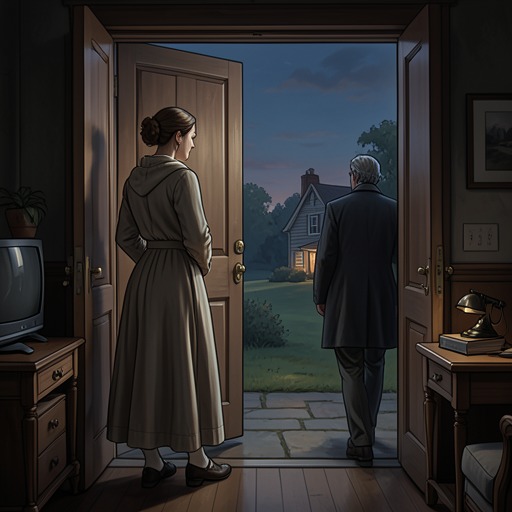
The reunion begins on the road to the Leonberger farm. Jefferson Kyle Kidd gets down first and offers Johanna his hand, but she has become blank again. Without turning her head, she looks toward the stone house, its long porch, fence, chickens, tools, barn, mesquite trees, and dogs. The waiting messenger smiles and stares at her; nobody speaks. The dogs gather around them, barking, until a man comes out and drives them off with a riding quirt.
The sound of German changes Johanna's stillness. She lifts her head at the command to drive the dogs away, then looks across the farmhouse and its outbuildings toward the surrounding brush country. She whispers the German words for aunt and uncle. Recognition is present, but it is brief and elemental: a response to language and kinship terms, not evidence that the intervening years have been undone.
Jefferson Kyle Kidd identifies himself and tells the family that he has returned their niece. He explains that Indian Agent Samuel Hammond ransomed her at Fort Sill in Indian Territory, then hands over the papers. Exhausted from the journey, with pain around his eyebrow and skull, he waits while Wilhelm reads. He says that he has brought Johanna all the way from Wichita Falls on the Red River. Wilhelm confirms the promised fifty dollars in gold; Jefferson Kyle Kidd says that he bought the wagon with it. Seeing the lettering for Curative Waters and the bullet holes, Wilhelm asks whether the harness came with it. The exchange makes the return at once a family matter and a transaction whose cost is measured in money, transport, and the equipment acquired for the journey.
Kinship and Competing Expectations
Before the reunion, Jefferson Kyle Kidd imagines that the news will bring a rush of family and neighbors, perhaps with the priest, songs, food, and questions in German. He anticipates relatives holding out tintypes of Johanna's parents and the dress she wore at six, urging her to remember. That expectation makes the actual return more complicated: the family may be eager to recover the child they lost, but their idea of recovery assumes that memory and European behavior can be summoned back into place.
Johanna encounters the relatives' house as an alien arrangement of objects. While Jefferson Kyle Kidd sits with coffee and seed cake, she crouches in a corner, arms clasped around her ankles, and studies the daguerreotypes, carpet, glass windows, covered drapes, ironstone dishes, and delicate tables. The rooms that signify home to the adults do not yet signify home to her. Their possessions are not neutral background; from her perspective they are strange objects collected and fixed inside an immovable house.
Wilhelm says that the couple is prepared to take Johanna in, but immediately describes the labor awaiting her. They have no children except a nephew working at a cattle establishment, and Anna needs help because there is much work to do. When Anna tells Johanna to get up from the floor, Johanna ignores her. Asked whether the child thinks she is Indian, Jefferson Kyle Kidd answers that he is afraid she does and reminds them that she is only ten. His appeal is for her relatives to take account of the identity and age of the child actually before them, rather than treat her return as a simple recovery of the girl they remember.
A Welcome That Does Not Reach Johanna
The next day, visitors come to celebrate the return of one of their own. Johanna does not join them. She bolts into the barn, climbs a ladder with her skirt tucked into her belt, and refuses to come down. When people climb partway up and speak to her in German, she throws down a sickle and a barking spud. Jefferson Kyle Kidd asks them to leave her alone for a while. The episode gives physical form to the gap between public welcome and personal safety: the community can celebrate her return, but its attention and efforts to draw her out do not make the gathering feel like refuge to her.
The celebration proceeds without its intended center. The people of D’Hanis gather around long tables of Alsatian food and Texas-style brisket; the priest shakes Jefferson Kyle Kidd's hand and praises the long journey. The guests talk and laugh among themselves, while a few glance toward the pole barn where Johanna is hiding. Wilhelm and Anna, by contrast, sit stern and cold among the neighbors, and few people speak with them. The scene contrasts the community's collective gratitude with the strained, private work of deciding what Johanna's place in the family will be.
Johanna's own voice remains outside that communal ceremony. She sings slowly and quietly to herself in Kiowa. The song may be a curse, a plea to the sun, praise for the Wichita Mountains, or a call for help; the narration does not settle its meaning. What is clear is that her language and cultural attachment have survived the return. Anna sees the singing and asks whether Johanna is glad to come back from the savages, but Jefferson Kyle Kidd hopes the couple will understand that Johanna considers herself Kiowa and needs quiet, peace, and gradual adjustment. His concern is not simply that she be housed, but that she not be forced to perform a return to the old identity on demand.
Legal Obligation and an Unfinished Homecoming
The question of taking Johanna in also has a legal and material dimension. She has no adoption papers. A messenger explains that Wilhelm and Anna are unlikely to adopt her because adoption would legally obligate them to support her and, according to custom, provide a dowry. They did not adopt their nephew. The distinction matters: accepting a child into the household is not the same as assuming the durable responsibilities that formal adoption would impose. Wilhelm's willingness to receive Johanna therefore exists alongside the family's practical needs and the limits of its commitment.
Jefferson Kyle Kidd sees the social evidence as well as the legal one. At the gathering, Wilhelm and Anna appear isolated from the neighbors, while Johanna remains hidden in the barn. The messenger tells him that he cannot leave her there. Jefferson Kyle Kidd's response is close to despair: he thanks the man, says he may visit, and insists that he must go before he begins to cry. His departure leaves the reunion unresolved. Johanna has been delivered to her relatives, but neither the formal return, the community's celebration, nor the household's offer of shelter has yet made the farm a place where she belongs.